
Local SEO is a low-cost, always-on marketing strategy that delivers real results for small businesses. Brick-and-mortar, service area, multilocation; there are smart, effective ways to use local search engine optimization to achieve your business objectives with long-term benefits.
In this local SEO guide, we’ll run through:
The basics of local SEO
Local SEO ranking factors
Local SEO keyword research
Plus, we’ll also offer ways to measure the effectiveness of your local SEO strategy.
What Is Local SEO?
Local SEO is the ongoing process of creating website pages and blog content based on localized keyword research to win visibility, traffic, and leads within a specific city, region, or service area. Local search engine optimization is critical for businesses across nearly every industry that primarily serve a local audience, such as:
Brick-and-mortar retailers
Home service companies (HVAC, plumbing, electricians, roofers)
Restaurants and coffee shops
Law firms
Events (festivals, races, etc.)
…just to name a few.
Why Is Local SEO Important?
Optimizing local keywords is all about relevancy and value. Winning top positions on the search engine results page (SERP) doesn’t just win eyeballs and sessions. It offers:
Relevant awareness and traffic. If you’re a remodeling company in Traverse City (that’s a perfect keyword, by the way), being number one for “remodeling company” is both very impressive and largely useless - you can’t remodel a house in Duluth.
Valuable keywords. Localized keyword research identifies search terms with immediate value. Again, being #1 on the SERP for “remodeling company in Traverse City” has a functional value (visibility and clicks) and a financial value because you can spend less targeting that term with Google Ads or Local Search Ads (LSAs), if you’re investing in paid search marketing.
The importance of local SEO lies in those two benefits, but it’s helpful to understand how it works compared to national SEO.
What’s the Difference Between SEO and Local SEO?
It’s all about intent. Brands that primarily operate online (think ecommerce, software, or any business that isn’t dependent on local patronage) use SEO to reach as many people as possible who fit their target audience. Multilocation businesses, whether they own two or three bike shops or hundreds of franchises nationwide (think Starbucks or Roto-Rooter), have to balance national and local SEO.
National vs. Local SEO
National and local SEO share considerable overlap in that they both target relevant keyword targets that relate to your business, industry, products, and services. The difference lies in local SEO’s “geomodifers”, which is an overfancy way of saying that they include national, regional, state, and city names.
Here are a few examples of national and local search optimization keywords:
National keywords
Bike shop
Coffee shops
Heater repair services
Ford dealership
Local keywords
Bike shop in Traverse City
Coffee shops in Lansing
Heater repair services in northern Michigan
Ford dealerships in Michigan
Starbucks near me (the local everywhere keyword!)
It’s important to note that many, many more people search for a term like “bike shop” compared to “bike shop in Traverse City”, which means holding a top position for that keyword will drive much more traffic, which is useless (unless you have some online sales offerings). While the local keyword likely gets a fraction of the monthly search volume, it’s easier for your brand to rank for and much more relevant and valuable - that’s why it’s worth targeting!
How Local SEO Works
The most important local SEO ranking factors are:
Proximity: A user searching for “coffee shop in Traverse City” will likely see results for coffee shops closest to them. There’s only so much you can do to overcome proximity, and all of those things are listed below.
NAP information: Having your business name, address, and phone number consistent across your website, Google Business Profile, and other listings is a huge signal for Google.
Engagement: How often users click through from the SERP to your site (and how long they stay on your site) influences where Google serves your site links.
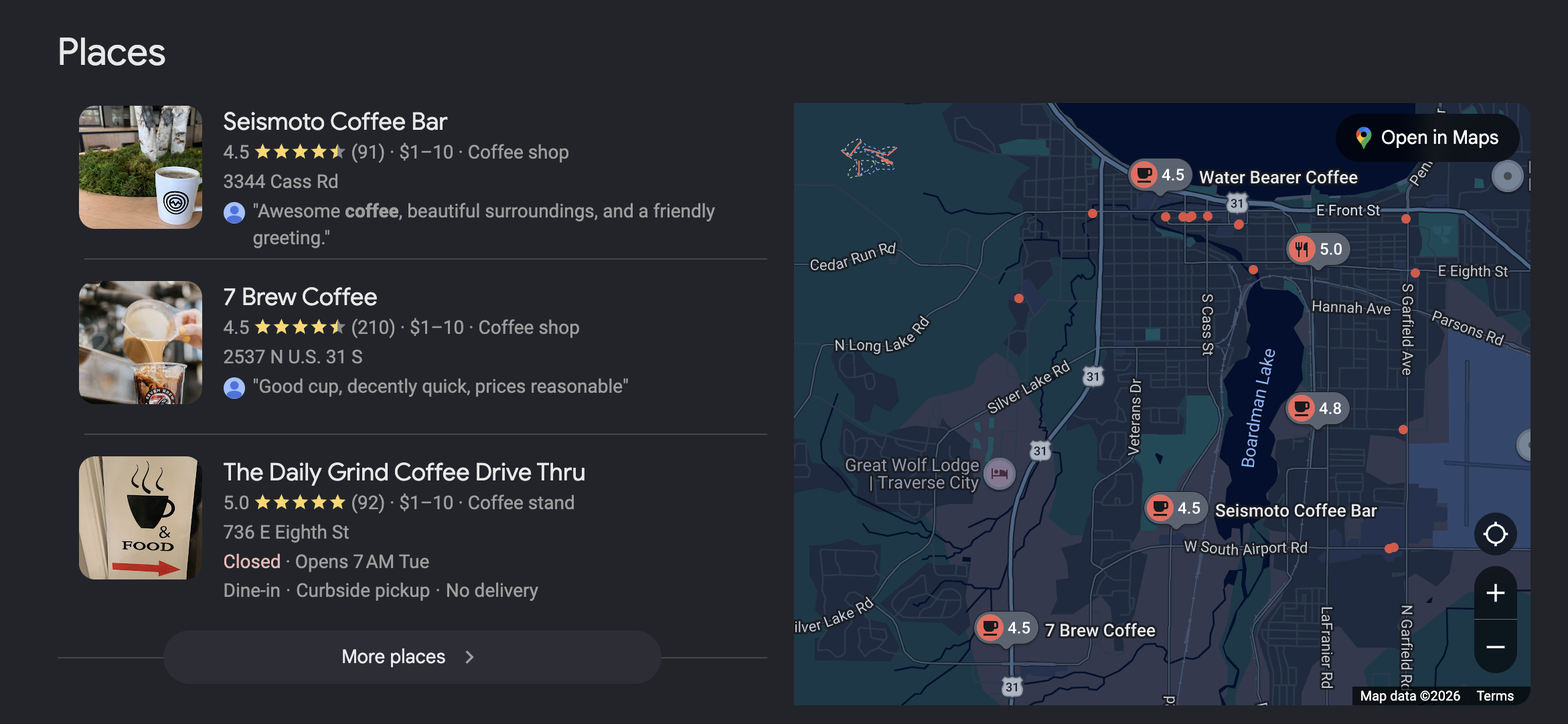
This Places result shows coffee shops throughout Traverse City; the three highlighted are (mostly) the ones closest to Sovis Media HQ.
The biggest local SEO ranking factor (aside from proximity) is your Google Business Profile. An optimized GBP listing (hey, we do that!) with many positive reviews is your best asset aside from your website, helping you appear in the Maps results that appear in most local organic searches. There are additional, more advanced local SEO factors we address through a technical site audit, but we recommend starting with your GBP profile, then focusing on local keyword research before getting into the technical (read: nerdy) stuff.
Read More: A Guide to Google Business Profile Optimization
How to Do Local Keyword Research
Local keyword research is relatively straightforward, but it’s helpful to have dedicated tools so you understand more about your local targets, such as:
Monthly average search volume, or how many times a keyword is searched on Google
Keyword difficulty, or how hard it is to rank for a specific keyword
You can use free (or paid, if you’re serious) versions of tools like Semrush and Ahrefs for your local keyword research. In most cases, you can start with some common sense. If you’re offering “bike rentals” and your store is in Traverse City, you can expect to work in a few variations of “bike rentals traverse city” onto your /bike-rentals page. Rinse and repeat for other pages on your domain, but don’t overdo it; keyword stuffing can actually hurt SEO performance and make you sound like a broken record.
Other local keyword research strategies include:
Use Autofill in Google to see what terms are suggested
Naturally turn keywords into questions (ex, “where is the best bike rental shop in traverse city”)
Look at the websites of your top competitors and use similar headings and structure when optimizing your pages
If you need help researching local SEO keywords, optimizing your website, or creating new content, get in touch.
How to Measure Local SEO Results
Measuring the effectiveness of your local SEO strategy requires:
A dedicated reporting tool (we use Google’s LookerStudio, Google Search Console, and Google Analytics)
Clear key performance indicators (KPIs)
A set timeline to base adjustments
Once your Google Analytics and Google Search Console are set up, create a dashboard (we do this for every client) that shows metrics like:
Session acquisition by channel
Top landing pages
SERP impressions and clicks
Key events (think phone calls, form fills, and purchases, among others)
Keywords (how many you hold and what positions those keywords are on the SERP)
Then, create some KPIs that reflect local SEO progress, such as:
Increase the number of keywords with “traverse city, michigan, northern michigan” and other local terms by 20% YoY
Increase impressions for queries that include “repair” by 20% YoY
Increase organic phone call clicks 30% YoY
If your business is seasonal (and many are in Northern Michigan), stick to YoY comparisons and adjust your goals to reflect your business objectives.
How Long Does Local SEO Take?
Local SEO typically starts working in 6-8 weeks, but it depends on how competitive your market and industry are and the overall health of your website. Winning top positions for “best HVAC company” is going to be easier in Traverse City than it is in Detroit because there are fewer competitors, most with smaller (relative) budgets.
How Much Does Local SEO Cost?
Local SEO offers a high return on investment (ROI) because the keywords used are typically very high intent. 72% of users who submit a local search visit or contact a store within five miles, often within 24 hours. We estimate every local SEO project based on several factors, including the scope of work, the inclusion of a technical site audit, the number of pages to optimize or create, and whether we’re providing other services at the same time.
Invest in Local SEO with Sovis Media
We strongly believe that local organic search is the foundation of any business’s marketing strategy. Before you run paid ads or start a TikTok, invest in your website’s technical health and publish SEO-rich keywords on your homepage, service and product pages, and a few high-performing blogs. With over a decade of digital marketing experience helping small businesses and international brands alike, Sovis Media has you covered.
Get in touch for a detailed look at how your website stacks up against local competitors, plus a clear path to improved local SEO results.